 Every day, drivers, pedestrians, cyclists, bus operators, farmers, and countless others travel across railroad tracks. No matter how you get around, one thing is for certain - understanding railroad signs and signals is essential for your safety. These indicators are designed to alert road users to the presence of tracks, guide them on how to cross safely, and warn of approaching trains. Some are passive, providing information and reminders, while others are active, using lights, sounds, and gates to demand immediate attention.
In this post, we’ll take a closer look at the different types of railroad signs and signals, what they mean, and why it’s so important for everyone from pedestrians to professional drivers to recognize and respect them.
Before the Crossing
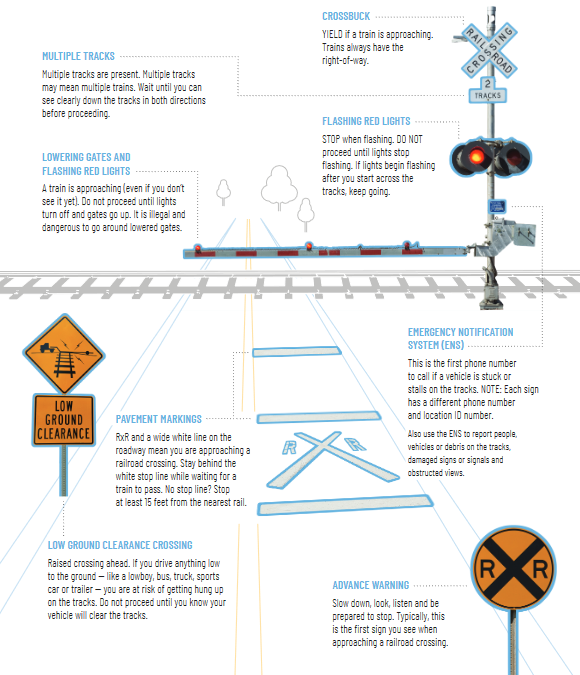
Advance Warning Sign
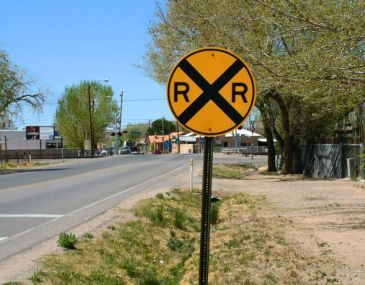 Slow down, look, listen, and be prepared to stop. Typically, this is the first sign you see when approaching a railroad crossing.
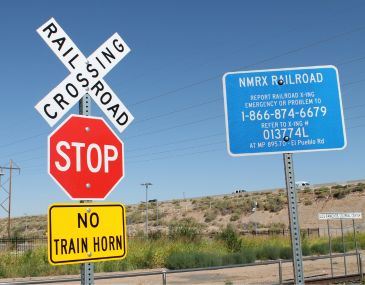
No Train Horn
A Quiet Zone has been established and normally the train will not sound the horn. The locomotive engineer can still sound the horn in emergency situations or if workers are near the tracks.
Advance Warning Signs for Side Streets
Indicates that tracks will appear immediately after making either a right or left turn and reminds drivers to be prepared if a train is coming.
On the Ground
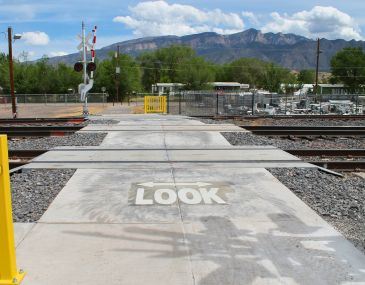 Pavement Markings
On paved roads and walkways, these markings alert drivers and pedestrians that the road or path crosses railroad tracks ahead and identifies the safe place to stop and look for an approaching train.
At the Crossing
Crossbuck
Marks the crossing and should be considered the same as a YIELD. This is the most common sign at public highway-rail intersections.
 Emergency Notification Sign (ENS Sign)
This is the first phone number to call if your car is stuck on the tracks. If it is missing, call 911. Each crossing in the USA has a unique USDOT Crossing Number.
Multiple Track Sign
Indicates the number of tracks present. After one train has passed, look and listen for another train coming from either direction.
Stop Sign
Just like any other stop sign on the road, a stop sign at a railroad crossing means the driver must come to a complete stop and look for trains, pedestrians, or other vehicles before proceeding.
Devices at the Crossing
Flashing Red Lights
When the red lights are flashing, a train is approaching. Stop and wait for the train to pass, then proceed when it is clearly safe to do so.
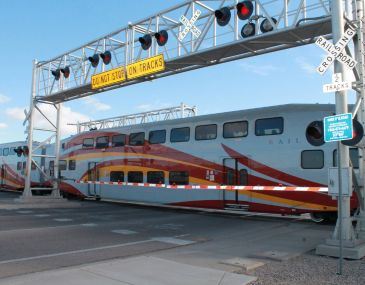 Flashing Red Lights & Gates
A lowering or lowered gate with flashing red lights means a train is coming. Do not try to “beat” a train by going around gates that are lowering or already down.
Cantilever Flashing Lights
Warns that trains are coming on roads with many lanes. These signals make sure that drivers in all lanes can clearly see the warnings.
Signs Along Railroad Property
No Trespassing
Warning to stay off the tracks and far away from the area as danger is present. If you attempt to walk, run, bike, or ride an ATV or any other motorized vehicle on or near the tracks, a railroad bridge, or train trestle you can be arrested and fined.
Teaching Tools
 It’s never too early to learn about being safe around trains! Rio Metro’s website offers printable activities and teaching tools that are free for parents, teachers, and students, including a Know Your Signs and Signals Word Scramble.
Additional Resources
Operation Lifesaver, Inc., a nationally recognized leader of rail safety education, provides a wealth of educational resources on their website for drivers and pedestrians. In addition to a detailed signs and signals guide, you can find videos, training tools for professional drivers, and more.
By Riann Martinez, Marketing Specialist, Rio Metro Regional Transit District
